

How FDA-Approved AI Tools are Revolutionizing Imaging Practices Across the Globe: Radiology’s New Ally
October 26, 2025
Each second counts while detecting a tumor, diagnosing a stroke, or catching a hidden bleed. Nonetheless, radiologists worldwide are under pressure to process millions of scans more quickly and accurately. Long wait times, fatigue and delayed care have become commonplace issues that could have disastrous consequences when time is of the essence.
FDA-approved artificial intelligence (AI) is the latest sort of partner that has entered the fray to combat the challenges. These clinically validated methods are no longer just used in research labs; they are now being integrated into routine processes. AI supports radiologists in their quest to quickly, accurately and equitably deliver results that address the most urgent issues by identifying the critical ones, concentrating on them and simultaneously attending to both emergency and community hospitals. It has been a long-standing belief that radiology is the only field of modern medicine that is exclusively technology-driven. However, the world now recognizes radiologists as one of the key contributors to this process.
Why Radiology Needed an Ally?
Radiology is a medical field that produces the most images. A CT scan can generate numerous pictures, and a radiologist typically reviews hundreds of these studies each year. With increasing patient numbers and growing pressure for speed, radiologists often feel exhausted and are at risk of missed diagnoses. Global shortages of radiologists add to the existing pressure. For example, in some areas, there is fewer than one radiologist per 100,000 people. That is where AI comes in, not as a replacement for radiologists, but to support their skills and provide quick, accurate care for each patient.
These challenges can cause delays, which can directly impact the survival of a patient in critical situations such as a stroke or trauma. Additionally, the intricate technology required for modern imaging, such as multi-phase CT, high-resolution MRI and PET scan, further presents challenges that may be beyond the capabilities of even the most accomplished specialists. Therefore, radiologists need AI rather than it replacing them. When triaging patients, AI can make quicker decisions, detect subtle abnormalities and ensure that critical cases are prioritized.
FDA Approval: The Trust Seal
According to the U.S. Food and Drug Administration (FDA), the AI device's 700 algorithms have been approved, primarily for radiologic tasks, representing more than three-fourths of the total. By obtaining FDA authorization, the algorithm demonstrated its utility and safety in specific clinical settings. It certifies to hospitals and doctors that these tools are not experimental—they are proven and ready for real-world use.
FDA clearance provides radiology AI a degree of legitimacy that accelerates real-world implementation. Compared with experimental software, FDA-approved algorithms have been strongly validated for precision, safety and adoption in clinical routines. For instance,
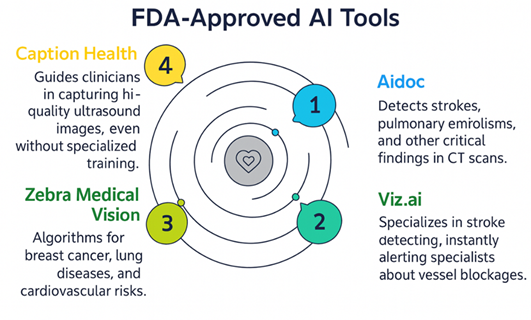
- Aidoc (Israeli Aidoc Medical Ltd.) is a health technology company that offers AI-based solutions. These solutions are implemented in hundreds of hospitals worldwide to detect pulmonary embolism, stroke and cerebral hemorrhage early, reducing the risk of death from treatment delays.
- Viz.ai (San Francisco, USA), a leader in intelligent care coordination, implements AI-powered stroke triage tools that enable neurologists and radiologists to communicate instantly.
- Zebra Medical Vision, an Israel based firm acquired by Nanox in 2021, developed FDA-approved algorithms for the detection of lung disease, cardiovascular diseases and cancers, that were aimed at population health screening.
- Caption Health (U.S., acquired by GE HealthCare in 2023) is known for Caption Guidance. This FDA-approved, AI-based ultrasound system enables doctors with limited training to obtain diagnostic-quality images.
Each approval builds confidence in clinicians and serves as a global reference point, making AI an increasingly trustworthy partner in healthcare diagnostics. Strategic partnerships that exemplify AI innovation are demonstrated through FDA-approved tools in radiology. Aidoc and NVI used the BRIDGE framework to develop guidelines for public managers on the ethical and efficient adoption of trustworthy AI in real-world medical applications, both locally and globally.
GE HealthCare and Caption Health have collaborated to develop AI ultrasound technology as a pilot for real NGO missions. Ultimately, what happens at the end of such projects is like what we all strive for: being at the forefront of invention, guided carefully to build legitimate trust and promote the full, worldwide use of clinical AI.
Source: BCC Research
From Scan to Report: AI’s New Workflow
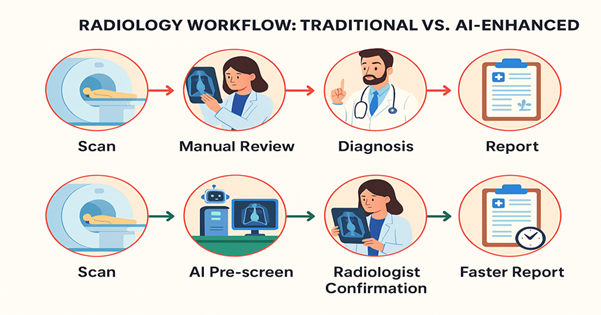
Earlier, the scans would be fed into the system, remain in a long queue for human review and eventually be processed with a report. First, AI can perform initial screenings of such images, detect deviations and sort the most relevant ones. While radiologists still make the final decision, with AI serving as their co-pilot, they can respond faster and with greater confidence. This workflow shift has tangible outcomes. In stroke treatment, where "time is brain," AI reduced door-to-treatment intervals by as much as 30 minutes, resulting in enhanced survival rates and patient outcomes. In breast cancer screening, AI-aided interpretations lowered false negatives by almost 9% and decreased recall rates. These benefits not only enhance patients’ lives but also save hospitals millions by reducing errors and legal risks.
Source: BCC Research
Global Impact Backed by Real-World Studies
The impact of FDA-approved AI technology in radiology is no longer limited to the U.S. Its spillover effects can be seen worldwide as other countries adopt similar technology and modify their regulatory schemes. In Europe, CE-marked AI systems are being increasingly adopted into national screening programs, particularly for the detection of breast cancer and monitoring lung diseases. Japan and South Korea, with their highly developed healthcare systems, have adopted AI imaging technology to deal with aging populations and radiology specialist shortages.
Several real-world trials demonstrate the quantifiable benefits of incorporating AI into the system. For instance, a multi-center study in the U.K. identified that AI-assisted mammography had the potential to cut radiologists' workload by almost half without sacrificing diagnostic quality. Another trial conducted in Canada demonstrated the benefits of faster triage of suspected strokes when CT scans were pre-screened by AI, resulting in up to 30 minutes of saved treatment time. Tuberculosis screening programs incorporating AI have yielded improved early detection rates in India, particularly in rural communities where specialist presence is limited.
Future Outlook: Radiology of the Future
Radiology is entering an era in which AI will go beyond detection to prediction and personalization. Emerging generative tools are already writing reports in real time, significantly reducing reporting time, while multimodal foundation models are being trained to read CT, MRI and radiographs at nearly radiologist-level proficiency. These technologies will not only identify disease but also track its progression and support more targeted treatment decisions.
Aidoc's recent introduction of the BRIDGE framework, created in partnership with Nvidia, is an illustration of this change. The framework sets new benchmarks for the safe scaling of clinical AI in the healthcare industry. The framework, which aims to facilitate the use of AI in hospitals worldwide, achieves this by emphasizing strong interoperability and transparent management as key elements in ensuring the safe and efficient deployment of AI in hospital settings. Shibuya's ideas and breakthroughs illustrate how the coming era of radiology will encompass not just performance improvement, but also trust, safety, and scalability. These advances indicate how radiologists of the future will become orchestrators of diagnostic intelligence, combining the precision of AI with human empathy and judgment to provide quicker, more patient-centric care worldwide.
Radiology tech AI is getting better. It goes beyond simply finding things. Now, CT, MRI, PET and X-ray scans can all be viewed together quickly. Aidoc and NVIDIA's BRIDGE, Siemens and Microsoft Azure, and GE HealthCare are utilizing Caption Health's AI ultrasound technology to help develop this new type of intelligent system. It mixes people's skills with the machine's accuracy. It's growing to be safe and good to use.
Conclusion
Radiology's path has always been about clarity. With FDA-cleared AI solutions, that clarity is brighter, smarter, and quicker than ever before. AI is not replacing radiologists but is radiology's new partner, assisting in saving lives, streamlining workloads, and bringing care to more parts of the world. Notably, this union of radiologists and AI represents a significant shift in the practice of medicine itself. Robust partnerships and well-thought-out strategic investments have been the primary factors in advancing the industry to the next level. Medtech multinational companies are seeking collaboration with AI startups and university laboratories to create closed-loop systems—devices that can automatically and instantly stimulate nerves. These kinds of therapies, to be honest, are being rolled out slowly by public and private healthcare organizations in the U.S. and Europe as part of their chronic disease management systems.
The future of radiology is not about conflict between technology and humans, but rather about collaboration between these two forces to improve the world.
Need custom marketing data, insights, or further details? Reach out to us at info@bccresearch.com
BCC Library Membership Benefits
Unlimited Access to Market Research Reports for Academic Institutions and Corporations.
Custom Research
Tailored solutions across industries for your unique business needs.
MEMBERSHIP
Members get unlimited category or collection access, plus exclusives, events and discounts.
EXPLORE BENEFITSCUSTOM MARKET RESEARCH
Why go off-the-rack when you can go bespoke? Custom projects can be researched to match your unique needs.
FIND OUT MORE