

Nanocatalysts: Small Particles, Large Impact
November 12, 2025
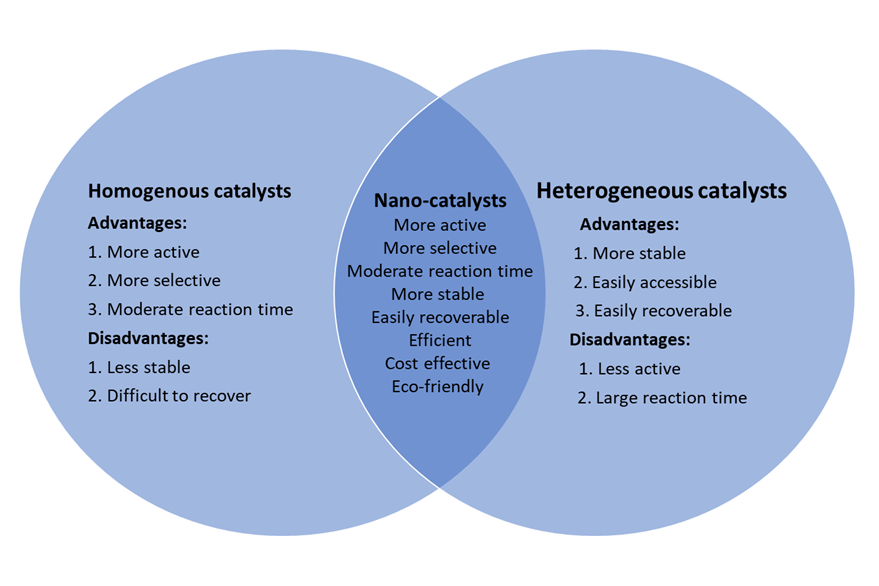
Nanocatalysts represent a novel catalytic system that combines the advantages of both homogeneous and heterogeneous catalysts. They consist of nanoparticles or other nanostructures (such as nanofoam), which are engineered with dimensions ranging from 1 to 100 nanometers. The most notable advantage nanocatalysts have over conventional materials is their significantly greater surface area-to-volume ratio, which increases the area over which a driven reaction can be catalyzed. The use of nanostructures may allow for specific control of surface strain or the arrangement of surface atoms. The figure below illustrates unique properties such as improved reactivity, stability and selectivity compared to traditional catalysts.
Nanocatalysis Through Time: Milestones in Design and Application
Nanocatalysis is the area of catalysis that is much more reactive and selective than bulk catalysts. Over the past few years, nanocatalysis has evolved, as illustrated in the figure below, showing its growing importance in contemporary science and industry.
Performance-Based Factors Driving the Nanocatalyst Adoption
- Efficiency and selectivity are high: Nanocatalysts have large surface-to-volume ratios that increase the number of active sites and improve reaction rates. Thus, increasing selectivity to desired products and minimizing undesired byproducts.
- Increased stability and recyclability: Advances in nanocatalyst design, such as core-shell structures and magnetic properties, improve stability under harsh conditions and reduce separation time from the reaction mixture. Thus, making them reusable further decreases the cost and waste.
- Energy efficient: Nanocatalysts work at lower temperature and/or pressure, thereby reducing energy and lowering the potential for greenhouse gases.
- Tunable properties: Innovation in synthesis methods allows researchers to choose the size, shape, and surface composition of nanocatalysts, enabling the design to be used for specific applications.
Challenges in Nanocatalysts
Nanocatalysts face significant challenges that hinder their practical and widespread usage. The primary challenge will be producing catalytic activity versus stability. The smaller catalysts exhibit extremely high activity due to their substantial number of active sites; however, they tend to sinter. The larger catalysts or supported nanoparticles are stable and have lower liabilities for sintering, but are less reactive. Their strategy to balance activity with stability incorporates adjustments to material composition, surface modifications and core-shell configurations. Other prominent challenges include:
- Stability under harsh reaction conditions for extended lengths of time.
- Agglomeration or leaching of nanoparticles.
- Scalable production of nanoparticles is inexpensive.
- Production of reproducible results.
Future Outlook: Innovations Leading the Next Generation of Nanocatalysts
- The single-atom and dual-atom catalysts' efficiencies and special electronic coordination to improve the activity and selectivity while minimal precious-metal loading are expected to feature most positively in the next generation of catalysts. For example, in August 2025, a research team from Politecnico di Milano developed a single-atom catalyst that can selectively control its chemical activity, which represents an advancement in sustainable chemistry and the development of efficient and programmable industrial processes.
- The availability of high-throughput screening of catalysts using artificial intelligence and machine learning will allow the discovery of catalysts whose composition, nanostructure, and interface can be based on predictable optimality. It enables shortening the empirical trial-and-error path to locating the better-performing catalysts.
- Although enhancing stability under realistic operating conditions (thermal sintering, metals leaching and nanoparticles agglomeration) will always be difficult. The various strategies, such as core-shell architectures, strains and support interactions, will be among the potential mitigations.
- Emphasis on more sustainable synthetic approaches (green solvents, renewable precursors and life-cycle analysis) in developing nanocatalysts that more closely align with the environmental and normative regulatory landscape is expected to expand. For instance, in September 2024, Researchers at Rice University discovered an approach to maintaining appropriate surface strain in nanocatalysts. This discovery is expected to create opportunities for broader applications, including the development of more effective catalysts that reduce greenhouse gas emissions and the generation of clean energy. Thus, the transfer of laboratory advancements to industry applications will necessitate consideration of scale-up, reproducibility, cost and safety regarding nanoparticles.
Conclusion
Nanocatalysts present compelling opportunities to adjust activity, selectivity and durability for many reactions as they have large surface-to-volume ratios and can be designed with specific physicochemical properties. Recent developments in interface engineering and controlling morphology have the potential to make a significant advance in the state of catalysis. However, stability under practical operational conditions, as well as safety and environmental concerns, remain critical considerations.
Tackling these issues will require interdisciplinary collaboration among materials science, computational chemistry, and process engineering, as well as sustainable approaches to their synthesis and lifecycle issues. In September 2025, researchers from Chung-Ang University in Seoul and Qingdao University of Science and Technology reported a ruthenium nanocatalyst designed for hydrogen production from seawater, marking a clear case of moving from proof of concept to proof of practical application of nanocatalysts as a transformational enabler in green chemistry and sustainable industrial processes.
Need custom marketing data, insights, or further details? Reach out to us at info@bccresearch.com
BCC Library Membership Benefits
Unlimited Access to Market Research Reports for Academic Institutions and Corporations.
Custom Research
Tailored solutions across industries for your unique business needs.
MEMBERSHIP
Members get unlimited category or collection access, plus exclusives, events and discounts.
EXPLORE BENEFITSCUSTOM MARKET RESEARCH
Why go off-the-rack when you can go bespoke? Custom projects can be researched to match your unique needs.
FIND OUT MORE