

Neuromorphic Computing: Driving the Future of Brain-Inspired Technology
November 17, 2025
Introduction and Background of Neuromorphic Computing
The human brain’s capabilities related to the computational and analytical structure have always been a topic of wonder for scientists and researchers. For centuries, efforts have been made to emulate its capabilities. Neuromorphic computing is a type of computing system that is inspired by the neurological structure and functioning of the human brain. Similar to the neurons in the human brain that help in transferring information, performing various actions and responding to stimuli, the neuromorphic computing system is composed of spiking neural networks (SNNs). These SNNs consist of spiking neurons and synapses that help store, process and transfer data by saving time and energy consumed in the process.
The Evolution of Neuromorphic Computing
Source: BCC Research
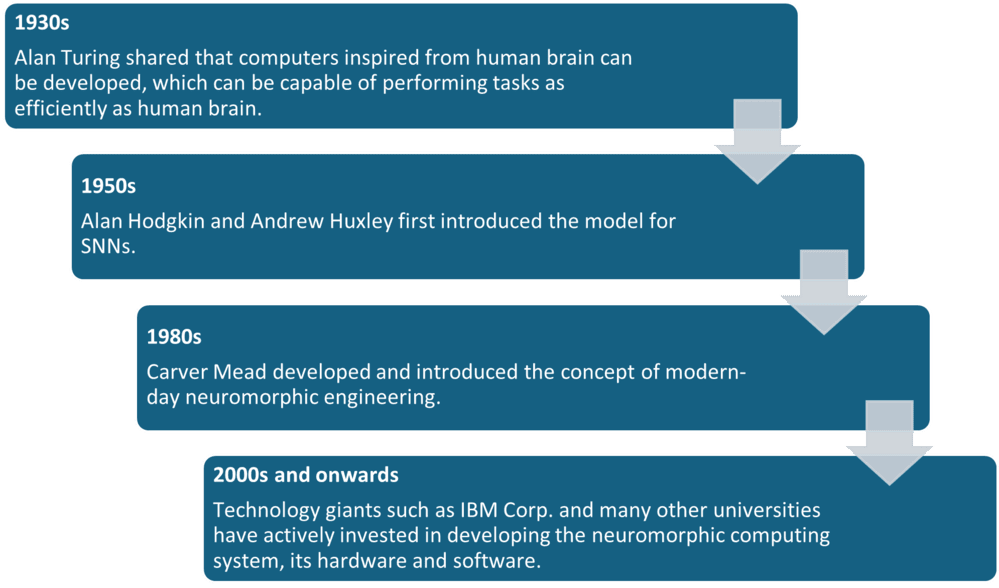
Although the theoretical foundations of this technology date back to the 1930s, it gained traction in the 1980s with advances in computational neuroscience. Alan Turing’s pioneering work on computable functions demonstrated that machines could execute logical operations through algorithms, establishing the groundwork for modern computing and artificial intelligence. In the 1980s, Carver Mead and other researchers, such as John Hopfield, investigated how biological systems perform computations, leading to the development of neuromorphic engineering. Mead, often referred to as the father of neuromorphic computing, designed systems primarily for experimental study of brain processes rather than for practical computational use.
The Growth Trajectory of Neuromorphic Computing from Concept to Global Research Focus
Neuromorphic computing, largely supported by spiking neural networks (SNNs), replicates human-brain-like functions and communication by executing actions only in response to specific events or stimuli. SNN, first developed by Hodgkin and Huxley in 1952, served as a basis for data storage and processing, much like the human brain. Since this discovery, continuous research and investment have been made to develop this technology at both industry and academic levels, leading to advancements in both hardware and software. By the early 2000s and 2010s, major technology companies, including IBM Corp., began investing in the development and innovation of neuromorphic computing technologies.
For instance, in May 2025, the U.K. Multidisciplinary Centre for Neuromorphic Computing, led by Aston University and supported by leading universities and institutions such as Oxford and Cambridge, among others, embarked on a collaborative effort to study and develop neuromorphic systems. Their research focuses on designing and developing the required hardware and software systems that replicate the human brain and its functioning. The center also shared that it has been funded with around $7.6 million by the Engineering and Physical Sciences Research Council (EPSRC) to work on this project.
Innovations Driving Neuromorphic Hardware and Efficiency Improvement

Source: BCC Research
Companies such as Intel Corp. and IBM Corp. have also been involved in developing hardware and chips designed to support energy-efficient neural activities in computers, which also act as a base for their network interface, enabling smooth and faster functioning. For example, NorthPole neuromorphic chip by IBM, introduced in October 2023, is the enhanced version of TrueNorth. The chip is designed to offer higher space efficiency, improved energy efficiency and lower latency than any other chips and is expected to be around 4,000 times faster than their earlier chip, TrueNorth.
Barriers to Market Scaling and System Integration
Though the hardware needed for neuromorphic computing is already developed, software development is still in process. Currently, Lava is one of the widely used software; however, wider options are not yet available, which also acts as a barrier for the growth of neuromorphic computing. Moreover, it is necessary to check the integration capability of both hardware and software, as the software required for neuromorphic computing does not work well with the Von Neumann hardware system, as stated by IBM Corp.
This hardware type is not preferred for neuromorphic computing, as its operational process of separating memory and processing slows down its speed and energy efficiency. Neuromorphic computing, on the other hand, integrates memory and processing in a single unit, making its hardware and software requirements different than traditional ones. Factors such as the development of algorithms suitable for this computing system and the lack of set tasks, datasets and benchmarks also act as barriers.
Benefits of the Neuromorphic Computing Growth
Despite various restricting factors, benefits such as parallel processing, energy efficiency and faster processing times are driving the growth of neuromorphic computing. One of the significant factors contributing to its growing preference is its energy efficiency feature. With the growing use of data and the adoption of AI, the dependency on data centers has been skyrocketing, resulting in increased energy consumption. The International Energy Agency (IEA) reported that total electricity consumption in data centers was approximately 415 terawatt-hours, equivalent to 1.5% of global electricity consumption in 2024, representing a 12% increase over the last five years, from around 2019 to 2024.
The neuromorphic computing system helps reduce electricity consumption, as this computing method utilizes systems that combine memory and processing units, thereby minimizing the energy required for data shuffling in both data storage and processing, unlike traditional systems. Furthermore, with the use of SNN, this system supports parallel processing, as each neuron in spiking neural networks can perform separate tasks without affecting the other functions that are occurring simultaneously. This enables the performance of multiple tasks simultaneously, thereby improving efficiency while saving time without compromising on speed and quality of outputs.
Real-Time and Growing Opportunities of Neuromorphic Computing
The neuromorphic computing system is capable of real-time learning and adaptability. Any real-time updates and data changes can be quickly interpreted and integrated into the system, which can then be utilized for future operations, thereby benefiting the user and enhancing the system's efficiency. Due to these benefits, neuromorphic computing is used for various purposes; a few of them are listed below:
|
Application |
Description |
|
Robotics |
Collect, analyze and transfer data faster for decision-making to perform various tasks. |
|
Autonomous Vehicle |
Beneficial for quick and real-time analysis of data collected through sensors, improved collision avoidance and navigation purposes. |
|
Edge AI |
Due to its adaptability, event-driven support and functionality, it is suitable for devices such as smartphones and wearables. |
|
Cybersecurity |
By tracking or detecting unusual patterns, neuromorphic computing can help identify and prevent cyberattacks due to its low-latency and faster operations. |
Source: BCC Research
In the coming years, with the growing integration of AI, it is expected that these computing systems will also be used in finance, government and other sectors, and support functions such as speech and image recognition in smartphones and other devices. With the growing dependence on AI and ML, and the resulting energy crisis from its high usage, the demand for neuromorphic computing is expected to grow at a faster rate.
The Road Ahead for Neuromorphic Computing
The future of neuromorphic computing is expected to unfold along multiple complementary paths. In the near term, practical adoption will focus on narrow edge use-cases where energy efficiency and real-time processing are critical. Industrial monitoring, automotive in-cabin sensing and low-power robotics applications will benefit from always-on perception and sensor-fusion capabilities. By combining event-based sensors with neuromorphic processors, these solutions offer a highly efficient and low-latency approach, making them ideal for energy-constrained, edge-deployed systems. Businesses that leverage these early commercial sweet spots can gain operational efficiency, reduce energy costs and deliver smarter and responsive services in real-time.
In the longer term, neuromorphic computing is expected to influence mainstream architecture and hybrid systems. Neuromorphic processors will handle sparse, event-driven tasks, while conventional accelerators manage dense matrix computations, creating hybrid platforms that optimize both performance and energy efficiency. At the same time, government and academic research will focus on larger brain-scale platforms, SpiNNaker and BrainScaleS, enabling advanced scientific modeling and algorithmic innovation. These large-scale systems accelerate neuroscience experiments, generating insights and algorithms that can inform commercial designs. Continued improvements in software stacks, developer tools and standard interfaces will be critical to enable broader adoption of neuromorphic computing across industries.
Need custom marketing data, insights, or further details? Reach out to us at info@bccresearch.com
BCC Library Membership Benefits
Unlimited Access to Market Research Reports for Academic Institutions and Corporations.
Custom Research
Tailored solutions across industries for your unique business needs.
MEMBERSHIP
Members get unlimited category or collection access, plus exclusives, events and discounts.
EXPLORE BENEFITSCUSTOM MARKET RESEARCH
Why go off-the-rack when you can go bespoke? Custom projects can be researched to match your unique needs.
FIND OUT MORE