

Head-Up Display (HUD) Technology: Driving the Next Generation of Intelligent Mobility
Expert guidance to accelerate your market and strategy decisions.

The global market for heads-up displays (HUDs) was valued at $7.5 billion in 2025 and is projected to reach $13.7 billion by the end of 2030, at a compound annual growth rate (CAGR) of 12.8%.
The
surge in adoption of advanced driver-assistance systems (ADAS) and digitally
connected vehicles is driving the growth of the heads-up
display (HUD) market. HUD systems are see-through display technology designed
to offer critical information directly into the user's line of sight to enhance
situational awareness and reduce distractions. These displays are used in
digital cockpits and intelligent mobility solutions, owing to their ability to
offer information such as navigation guidance, speed, safety alerts, and
operational data without diverting the user's attention. The market is also
driven by the growing demand for enhanced driving safety solutions paired with
the continuous advancements in AR-HUD and windshield projection technologies. This
article is a summary of the HUD industry trends, market dynamics,
opportunities, challenges, and other factors that are contributing to the HUD
market growth.
GROWING IMPORTANCE OF HEAD-UP DISPLAY (HUD) TECHNOLOGY
HUDs within the next-generation automotive and aviation industry offer high-contrast, real-time visual images that keep drivers' attention on the road while providing essential information, such as navigation directions or safety warnings, within the driver's direct line of sight. These displays are considered a crucial part of modern digital cockpit solutions, as HUDs offer an effective way to convey visual information without creating distractions.
With the surge in implementation of HUD technology within smart glasses, companies such as Ray-Ban, Samsung, and Meta are leveraging these advances to develop miniaturized, lightweight, and energy-efficient display solutions. This offers opportunities for HUDs across new emerging industries, including consumer electronics and healthcare. As adoption rises, HUD manufacturers can tap into new revenue streams and expand market applications, making AR-enabled smart glasses a key driver of growth for the HUD ecosystem.
MARKET DYNAMICS AND TRENDS
The growing adoption of HUDs in the automotive industry is driven by their integration with ADAS, AI-based driver monitoring systems (DMS), and sensor-fusion technologies. With rising demand for digital cockpit solutions, the need for ADAS is growing, encouraging OEMs to develop next-generation HUD technology. Apart from this, the surge in government initiatives such as the U.S. Department of Transportation's (USDOT) Automated Vehicle Framework, Euro NCAP Vision 2030, and Japan's Mobility Digital Transformation (DX) Strategy is driving the adoption of advanced automotive safety technologies. This is expected to drive the integration of in-vehicle safety and driver assistance solutions, including HUDs and ADAS.
Additionally, with the surge in demand for next-generation premium electric vehicles (EVs), the automotive industry has seen a strong surge in demand for advanced safety and security solutions such as ADAS and HUD. These vehicles are incorporating increased use of HUDs and AR-HUD technologies to deliver navigation, energy usage, safety warnings, and ADAS information to drivers in their immediate line of sight.
INDUSTRY RESTRAINTS
The HUD industry faces various challenges, primarily from the high costs associated with building HUD systems and the complexity of integrating these components into vehicles. With expensive projection units, specialized windshields, and advanced optics, the cost of deploying a HUD solution grows. Additionally, the HUD system requires extensive testing and validation, based on various industry standards, which result in high overall production costs and delays in product commercialization.
MICROECONOMIC FACTORS IMPACTING THE HUD MARKET
Geopolitical tensions globally are emerging as one of the most critical factors reshaping the growth of the HUD market, owing to its impact on global supply chains, manufacturing investments, technology accessibility, and raw material availability. One such example of this is the China and the U.S. trade and tariff war, resulting in a surge in prices on electronic components, automotive parts, and display technologies. Apart from this, ongoing conflicts between Russia and Ukraine and the tensions between the U.S and Iran have highlighted the growing need for battlefield visualization solutions, leading various developing and developed countries to increase their defence budgets. This trend is expected to create significant growth opportunities for HUD technology across the defence industry, particularly in the military and aviation sectors.
REGIONAL INSIGHTS AND EMERGING MARKETS
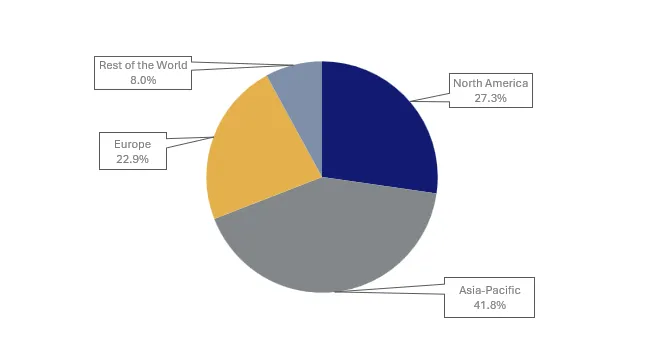
The global HUD market is dominated by the Asia-Pacific region, which accounted for over 41.8% of the global market, followed by North America with over 27.3% in 2025. The China HUD market region accounts for a major share of the Asia-Pacific HUD market and accounted for $1,902.5 million in 2025 and is projected to grow at a CAGR of 14.6% by the end of 2030. Apart from this, South Korea and Japan within the Asia-Pacific HUD market are advancing at a steady pace, driven by government initiatives such as the Mobility Digital Transformation (DX) Strategy by Japan and a liquidity package worth $2 billion by South Korea in FY2025. These initiatives by the government was aimed to support advanced manufacturing and new vehicle technologies, while strengthening the regional HUD industry in this region.
Additionally, the India HUD market is expected to grow with the highest CAGR of 17.9% during the forecasted period of 2025 to 2030. This growth is driven by the increased adoption of ADAS and digital cockpit technologies paired with the growing government support for automotive manufacturing to develop a domestic automotive ecosystem. Furthermore, the growth of HUD technology within this region is driven by the large automotive manufacturing base and the increasing use of HUDs in passenger vehicles, electric vehicles (EVs), and some aerospace applications.
Source: BCC Research
Additionally, in North America, the HUD market in
2025 accounted for 27.2% and is projected to grow at a CAGR of 13.3% during the
period of 2025 to 2030. The North America HUD market is dominated by the U.S.,
which accounted for $1,667.4 million in
2025. The North America HUD market witnessed a surge in demand for HUD
solutions, owing to its strong defence budget for next generation mission
critical equipment’s paired with the surge in demand for ADAS-enabled
automotive solutions. The European market for HUDs accounted for 22.9% of the
global market in 2025. In this report, the European market is divided into
Germany, the U.K., France, Italy, and the rest of Europe. France has the
largest market share, generating $472.5 million in revenue in 2025, driven by
its strong automotive and aviation sectors.
CONCLUSION
The HUD technology in the automotive industry is currently undergoing an innovation cycle driven by increased demand for safety features in the mid-range motor vehicle segment. To address this demand, OEMs operating in the HUD supply chain are developing cost-effective solutions by reducing their reliance on Tier 1 suppliers. Despite this, the global HUD industry is dominated by Tier 1 and global electronics manufacturers, resulting in limited accessibility for new startups. To overcome this, the global automotive manufacturers are developing new partnerships with small- and medium-sized HUD enterprises to strengthen the adoption of this technology in the coming years.