

The Rise of Intelligent Ground Robotics: A New Chapter in Military Innovation
Expert guidance to accelerate your market and strategy decisions.

The global market for unmanned ground vehicles (UGVs) was valued at $7.8 billion in 2025 and projected to reach $13.1 billion by the end of 2031, at a compound annual growth rate (CAGR) of 9.7% from 2026 through 2031.
The increasing demand for automation and autonomous systems in the defence and commercial sectors is driving the adoption of advanced robotics. UGVs are important in executing high-risk operations such as explosive ordnance disposal (EOD), border surveillance, search and rescue, and hazardous material handling. They are also essential for modern industrial processes, including automated warehousing, agricultural monitoring, and tactical logistics transport. This article provides a summary of industry trends, market dynamics, and other factors contributing to the growth of the UGV market.
FUTURE OF UGVs
The UGV market is shifting from remote-controlled tools to autonomous, modular partners, redefined by AI-driven navigation, payload flexibility, and the ability to operate seamlessly alongside human teams in complex environments. Technological trends, such as swarm intelligence and manned-unmanned teaming (MUM-T), enable fleets of smaller robots or autonomous wingmen to safely handle hazards. Meanwhile, the adoption of hybrid-electric and hydrogen power sources enables extended remote operations without refuelling frequently. Highlighting this shift, in March 2026, General Dynamics, Epirus, and Kodiak AI launched the Leonidas Autonomous Ground Vehicle. This prototype integrates an AI-driven driving system and a high-power microwave platform onto a commercial truck chassis. This design perfectly illustrates the industry's shift toward autonomous, modular partnerships and flexible payloads. By countering drone swarms and protecting critical infrastructure without human intervention, this vehicle proves that autonomous wingmen can safely handle high-hazard defence missions.
MARKET DYNAMICS AND TRENDS
Rising defence budgets and security threats are the key growth factors for the UGV market. The demand for UGVs is also driven by the modernization of military forces and homeland security, necessitating autonomous capabilities. Furthermore, the surge in smart farming, cross-border disputes, and high-risk missions is boosting the deployments of advanced UGVs. Additionally, the shift toward higher fleet densities and complex multi-domain architectures requires technologically advanced equipment and interoperable communication systems, which is one of the crucial growth levers for the UGVs market.
The growing focus on personnel safety and operational continuity in dangerous environments is leading to innovation in resilient, multi-terrain automation technologies. Integrating advanced AI allows these vehicles to navigate unpredictable environments and make real-time decisions on the battlefield. Furthermore, government initiatives such as the European Union's iMUGS2 project, launched with a $63.40 million investment in 2026, have improved collaborative defence manufacturing capabilities.
MARKET CHALLENGES
The UGV market faces significant challenges, primarily due to complex, muddy terrain. Navigation failures remain a concern, as difficult environments increase the risk of accidents and raise teleoperation costs. Additionally, the industry faces vulnerabilities such as GPS spoofing and electronic warfare threats, leading to heavy investments in encrypted communication and sovereign compliance.
IMPACT OF THE GEOPOLITICAL CONFLICTS
The ongoing war between Russia and Ukraine highlighted the growing importance of these vehicles and has shifted the development progress of UGVs from experimental tools to critical, AI-driven assets. According to Ukraine's Ministry of Defence, in 2025, UGV manufacturing surged by 650%. This rise in production resulted in nearly 24,500 successful front-line missions during the first quarter of 2026. These systems support vital front-line operations, specifically logistics, ammunition transport, and casualty evacuation. Furthermore, manpower shortages and heavy jamming in Ukraine have supported the industrial-scale deployment of autonomous, electronic-warfare-resistant UGVs for logistics and mine clearance (SLDinfo.com, 2025). Ultimately, these geopolitical conflicts emphasize the vital need for autonomous navigation and resilient supply chains, transforming ground robotics into essential force multipliers that reduce human casualties.
REGIONAL INSIGHTS AND EMERGING MARKETS
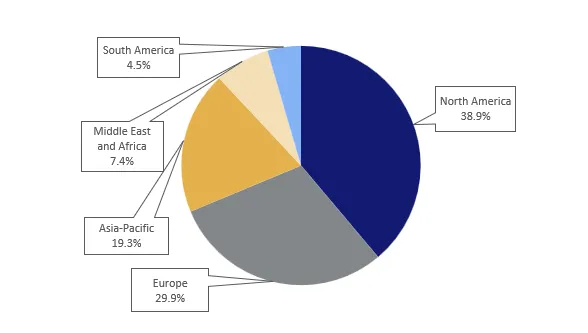
The global market for UGVs is dominated by North America, which accounted for 38.9% of the market share in 2025, valued at $3.0 billion. Driven by huge military spending and a shift toward automated logistics programs, the North American market is projected to reach $4.9 billion by 2031, with a compound annual growth rate (CAGR) of 9.2%. The U.S. market led the region with a value of $2.4 billion in 2025 and is projected to grow at a faster CAGR of 9.8% through 2031. This growth is heavily driven by shifting federal spending priorities. For instance, the Pentagon dedicated $13.4 billion to autonomous systems in its fiscal year 2026 budget plan. Within this total, the U.S. military is spending $210 million exclusively on autonomous ground vehicles.
Europe market is valued at $2.3 billion in 2025 and is expected to reach $4.1 billion by 2031 at a 10.3% CAGR. This European growth is heavily supported by regional initiatives such as the European Defence Fund, which assists procurement for security and industrial automation across major countries, including Germany and France. Meanwhile, the Asia-Pacific region represents the fastest-growing market worldwide, expanding at a CAGR of 11.5% from 2026 to 2031. China currently leads the regional market with a $533.9 million share in 2025, fuelled by defence modernization and border control initiatives. In addition, the market growth remains moderate in the rest of the world, driven by the lower baseline defence infrastructure and fragmented government investment.
Figure 1
Global Market Share for UGV, by Region, 2025 (%)
Source: BCC Research
CONCLUSION
The global UGV market is expanding rapidly, driven by rising defence budgets, geopolitical tensions, and an increasing need for automation. As technology shifts from simple remote-controlled tools to highly autonomous, AI-driven systems, UGVs are becoming essential for both military and industrial operations. Despite challenges such as harsh terrain and cyber threats, huge regional investments ensure that ground robotics will remain vital for future security and operational efficiency.