

Vapor Chambers: The Shift Toward Compact Heat-Spreading Solutions
Challenges and Safety Considerations of AI-Driven Imaging
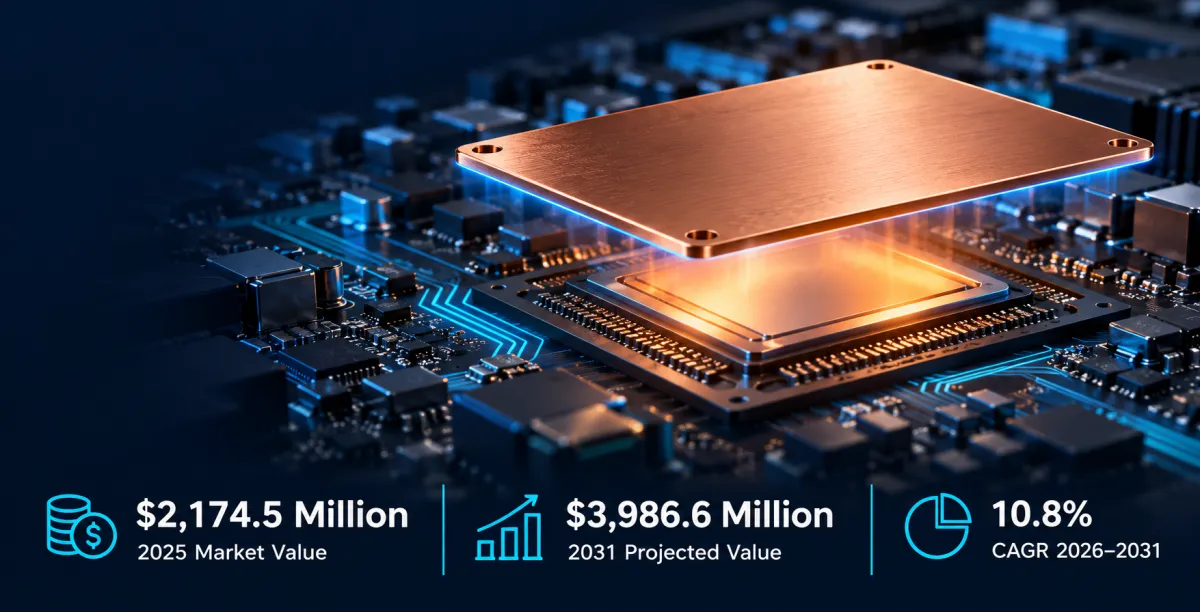
he global market for vapor chambers was valued at $2,174.5 million in 2025 and is projected to reach $3,986.6 million by the end of 2031, at a compound annual growth rate (CAGR) of 10.8% from 2026 through 2031.
The surge in demand for vapour chambers is driven by the rapid escalation of processor thermal design power (TDP) in consumer electronics and data center hardware. Vapor chambers are an essential part of modern thermal management systems, addressing the increasing heat loads generated by high-performance electronics such as CPUs, GPUs, and AI accelerators. Additionally, the usage of vapor chambers is not limited to high-end electronics but includes EV battery modules and even AR/VR devices. Developments in wicking technologies are playing a significant role in thinning down vapor chambers and enhancing their ability to manage higher heat fluxes. This article is a summary of the industry trends, market dynamics, opportunities, challenges, and other factors that are contributing to the vapor chambers market growth.
FUTURE OF VAPOR CHAMBER
The vapor chamber market is growing from traditional electronics solutions to next-generation advanced EV, AR/VR, and AI data center applications. With advancements in 5G-Advanced, reduced capability (RedCap), and AI-based chipset technologies, the vapor chamber market is witnessing growth across automotive, IoT, and satellite-enabled connectivity solutions. Meanwhile, the surge in demand for liquid cooling systems within the data center to manage AI workloads is creating opportunities for vapor chambers. One such example is NVIDIA, a global semiconductor and AI computing company, which, in March 2026, filed a U.S. patent application for a vapor chamber-based cooling apparatus for data centers. This new chamber is designed to cool ICs containing CPUs and multiple GPUs by using a vapor chamber in combination with a heat exchanger and coolant flow. These developments highlight the growing adoption of vapor chamber-based thermal management solutions across emerging electronics applications and AI data center infrastructure.
MARKET DYNAMICS AND TRENDS
The vapor chamber market is driven by the rise in demand for high-performance computing (HPC) solutions, which require efficient heat dissipation and thermal management, offered by vapor chambers. In line with this, Apple, a global smartphone and electronics solution provider, in September 2026, announced its iPhone 18 Pro and 18 Pro Max series equipped with a next-generation vapor chamber connected directly to the A20 Pro chip. These chambers were designed with a surface area approximately three times larger than that of the previous generation. Furthermore, the growing need for high-power systems on chips (SoCs), paired with the growing penetration of 5G technology, is propelling the need for advanced vapor chambers.
Additionally, the accelerating global EV adoption is opening new opportunities for vapor chamber technology in battery thermal management. Furthermore, the rise in AR/VR wearable technology is creating demand for ultra-thin, flexible vapor chambers that can offer efficient thermal management in compact device structures. For instance, Snap, a technology company, in August 2026, received a U.S. patent for an eyewear device that incorporates a planar vapor chamber. This shows new opportunities for the vapor chamber across emerging consumer electronics solutions.
MARKET CHALLENGES
The vapor chamber market faces significant challenges, primarily due to the excessive cost associated with the vapor chambers compared to traditional cooling solutions. Additionally, vapor chambers suffer from an inherent limitation due to their hollow and enclosed structure. Driven by the difficulty of repairing or modifying the internal structure once sealed, vapor chambers have limited flexibility for customization.
MACROECONOMIC FACTORS IMPACTING THE VAPOR CHAMBERS MARKET
The global DRAM shortage of 2025-2026 is creating a headwind for the vapor chamber market, owing to the surge in the cost of consumer electronics and servers, which can delay production and product upgrades, affecting demand for vapor chambers. According to a September 2026 report by the Financial Times, the AI-driven DRAM shortage was causing significant price increases in consumer electronics, subsequently impacting the growth of the vapor chambers market. Apart from this, rising power costs are another factor affecting the data center sector, influencing both the pace of data center build-out and the design options selected to control operating expenses. This surge in electricity and operational costs results in data center operators prioritizing energy-efficient solutions, which is restraining the adoption and deployment of advanced thermal management solutions, including vapor chambers.
REGIONAL INSIGHTS AND EMERGING MARKETS
The global vapor chambers market is dominated by North America, which was valued at $983.7 million in 2025 and accounted for over 45.2% market share. This growth is driven by the growing build-up of AI data centers and rising demand for consumer electronics, supporting the growth of the North American vapor chambers market at a CAGR of 11.2% through 2031. The U.S. market led the North American vapor chamber market with a 62.1% market share held in 2025. Driven by the surge in demand for AI data centers and high-performance GPUs, creating demand for advanced thermal management solutions. One such example is Nscale, a full-stack AI cloud platform, which announced approximately $3 billion in financing to support AI infrastructure deployments in Texas and North Carolina. Announced in August 2026, the financing will primarily fund the deployment of GPU infrastructure, networking, storage, and liquid-cooling equipment across both campuses.
Asia-Pacific market was valued at $540.7 million in 2025 and is expected to reach $1,128.6 million with a CAGR of 13.2% during the forecast period of 2026 to 2031. The market growth is driven by the convergence of three structural forces: the world's most dynamic EV market transition, rapid AI data center buildout, and an unparalleled consumer electronics manufacturing and consumption base. Apart from this, the European vapor chamber market was valued at $40.1 million and is expected to grow with a CAGR of 9.1% from 2026 to 2031. Within the European market, Germany led the market in 2025, due to its growing role as a hub for AI-driven data centers. Additionally, the rest of the world witnessed steady growth driven by growth in the areas of digitization, consumer electronics usage, and electrification.
Figure 1
Global Vapor Chambers Market Shares, by Region, 2025
(%)

Source: BCC Research
CONCLUSION
As devices are becoming more and more compact, the entire thermal management ecosystem is working to develop ultra-thin, flexible, and composite-material vapor chambers. From traditional smartphones and gaming applications, vapor chamber manufacturers are now moving towards AI accelerators, EVs, and AR/VR applications. This development is now driving the requirements for specialized materials, structures, and fluids, which may improve heat transfer efficiency and operational characteristics. From a strategic perspective, this new development is expected to create new opportunities for emerging startups and experts to enter the market. To ensure this, companies need to establish various strategic alliances between semiconductor OEMs, EV OEMs, and data center manufacturers to ensure that vapor chambers become standard thermal equipment rather than add-ons.