

Global Market for Nanoparticles in Biotechnology and Pharmaceuticals to Reach $79.8 Billion by 2019; Drug Delivery Systems Surging at 23% CAGR
October 16, 2014
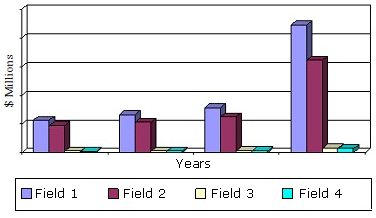
Wellesley, Mass., October 16, 2014 –BCC Research (www.bccresearch.com) reveals in its new report, NANOPARTICLES IN BIOTECHNOLOGY, DRUG DEVELOPMENT AND DRUG DELIVERY, the global market for nanoparticles in biotechnology and pharmaceuticals is expected to reach $79.8 billion in 2019, with a compound annual growth rate (CAGR) of 22% for the period 2014 to 2019. Drug delivery systems segment is surging at a significant CAGR of 23%.
The development of nanoparticles and their rapid incorporation into the research and development, formulation and production of drug products has given rise to a new area of biotechnology and pharmaceutical research involving particle materials in the nanometer size range. The biggest increase will come in the area of drug delivery systems. As products complete clinical trials and gain U.S. Food and Drug Agency (FDA) market approval, the revenues from these products are anticipated to grow at 23% CAGR.
The methods for producing nanoparticles vary depending on the starting substrate materials and the size particle desired as an end product. At present, the U.S. holds the largest number of patents in the nanoparticle area. This is largely due to the early commercialization of some nanoparticle products by U.S. companies. Europe is the second-largest market for nanoparticle drug technology. Drug formulation and delivery is attracting new players in Europe, and this in turn will contribute to the market’s development.
“A number of FDA-approved drugs are delivered using one form of nanoparticle, the liposome. There are several nanoparticle-related drug delivery systems in the pipeline of a number of major pharmaceutical companies,” says BCC Research biotechnology analyst Jackson Highsmith. “Clinical trials are in progress on some of these developments. There is potential in this technology for the successful development and application of future nanotech products to diagnose and treat various diseases.”
NANOPARTICLES IN BIOTECHNOLOGY, DRUG DEVELOPMENT AND DRUG DELIVERY provides a comprehensive and global analysis of the market for nanoparticles in the life sciences. Existing drug products and potential drugs in the pipelines of the major pharmaceutical players in this market are reviewed. It also seeks to address the critically important topics of analyzing and changing market dynamic, emerging players and products, and strategies for accessing emerging markets

Editors and reporters who wish to speak with the analyst should contact Steven Cumming at steven.cumming@bccresearch.com.
Nanoparticles in Biotechnology, Drug Development and Drug Delivery( BIO113B )
Publish Date: Aug 2014
Data and analysis extracted from this press release must be accompanied by a statement identifying BCC Research LLC as the source and publisher. For media inquiries, email press@bccresearch.com or visit www.bccresearch.com/media to request access to our library of market research.
BCC Library Membership Benefits
Unlimited Access to Market Research Reports for Academic Institutions and Corporations.
Custom Research
Tailored solutions across industries for your unique business needs.
More in Cell Biology
- Biometrics as a Service in Medical Devices to Reach $2.7 Billion by 2030, Driven by Remote Patient Monitoring Demand
- Protein Synthesis Research Market to Reach $42.8 Billion by 2031, Driven by Surging CGT Investment
- AI and Advanced Diagnostics Transform Cancer Detection Market Amid Rising Healthcare Investment
- Cloud Computing in Cell Biology, Genomics and Drug Development to Reach $15.6 Billion by 2030 as Biological Data Explosion Drives Demand
- Decentralized Clinical Trials Market to Reach $18.8 Billion by 2030 as Digital Health Infrastructure Reshapes Drug Development
Reports from Cell Biology
Recent News
- Global Bispecific Antibodies Market to Reach $22.3 Billion by 2030 as Immuno-Oncology Innovation and R&D Investment Accelerate
- Global Noninvasive Cancer Diagnostics Market to Reach $165.2 Billion by 2030 as Liquid Biopsy, AI-Enabled Screening and Multi-Cancer Detection Tests Transform Oncology
- Neuroprotective Agents Market to Reach $60.9 Billion by 2030 as Neurological Disease Burden and Aging Populations Drive Pharmaceutical Investment
- Long-Term Care and Home Healthcare Technology Market to Reach $64.8 Billion by 2030 as Aging Demographics and Remote Monitoring Reshape Care Delivery
- Radioligand Therapeutics Market to More Than Double to $4.8 Billion by 2030 as Targeted Cancer Treatments Gain Regulatory Momentum