

Medical Device Coatings
November 12, 2008
Wellesley, Mass—According to a new technical market research report, MEDICAL DEVICE COATINGS (HLC049B) from BCC Research, the global market for medical device coating technology is expected to be worth $4.2 billion in 2008. This will increase to over $4.7 billion in 2009 and reach $7.5 billion in 2014, for a compound annual growth rate (CAGR) of 9.9%.
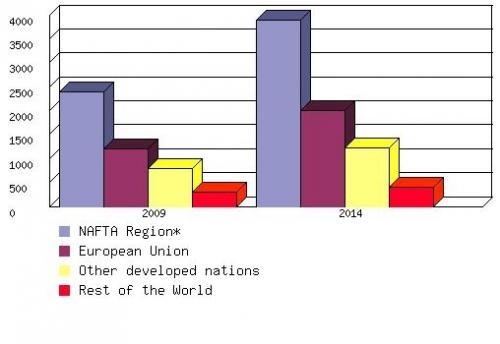
The market is broken down into the North American Free Trade Agreement (NAFTA) region which includes Canada, the United States and Mexico; the European Union; other developed nations; and the rest of the world. The NAFTA region has the largest share of the market, worth an estimated $2.1 billion in 2008. This should increase to $2.4 billion in 2009 and $3.9 billion in 2014, for a CAGR of 10.2%.
The European Union has the second largest market share, worth an estimated $1.1 billion in 2008. This is expected to increase slightly in 2009 and reach $2.0 billion in 2014, for a CAGR of 10.6%.
Other developed nations have the third largest market share, worth an estimated $715.0 million in 2008. This will reach almost $800.0 million in 2009 and $1.2 billion in 2014, for a CAGR of 8.9%.

After decades of occupying a highly specialized niche within the painting and coating industry, the medical device coating business has become the source for many advances in clinical medicine. These advances are fueled by the continuing development of high-value combination products and changes in Medicare policies that encourage greater use of antimicrobial-coated catheters and examining room surfaces.
Coatings will benefit most of the devices used in the recognized areas of medical specialization; however, not all disciplines will equally benefit. The greatest benefits of the addition of coating and surface treatment technologies will be in medical devices developed for general hospital use, personal use, general and plastic surgery, cardiovascular medicine and dentistry.
Medical Device Coatings( HLC049B )
Publish Date: Nov 2008
Data and analysis extracted from this press release must be accompanied by a statement identifying BCC Research LLC as the source and publisher. For media inquiries, email press@bccresearch.com or visit www.bccresearch.com/media to request access to our library of market research.
BCC Library Membership Benefits
Unlimited Access to Market Research Reports for Academic Institutions and Corporations.
Custom Research
Tailored solutions across industries for your unique business needs.
More in Health Maintenance
- Global Noninvasive Cancer Diagnostics Market to Reach $165.2 Billion by 2030 as Liquid Biopsy, AI-Enabled Screening and Multi-Cancer Detection Tests Transform Oncology
- Long-Term Care and Home Healthcare Technology Market to Reach $64.8 Billion by 2030 as Aging Demographics and Remote Monitoring Reshape Care Delivery
- Thermo Fisher Scientific Inc.: BCC Research Releases Comprehensive 360° Company Analysis
- Healthcare Predictive Analytics Market to Grow at 24.7% CAGR Through 2030
- mHealth Technologies Market Poised for 17.1% CAGR Growth Through 2030
Reports from Health Maintenance
Recent News
- Biometrics as a Service in Medical Devices to Reach $2.7 Billion by 2030, Driven by Remote Patient Monitoring Demand
- Protein Synthesis Research Market to Reach $42.8 Billion by 2031, Driven by Surging CGT Investment
- AI and Advanced Diagnostics Transform Cancer Detection Market Amid Rising Healthcare Investment
- Global Bispecific Antibodies Market to Reach $22.3 Billion by 2030 as Immuno-Oncology Innovation and R&D Investment Accelerate
- Cloud Computing in Cell Biology, Genomics and Drug Development to Reach $15.6 Billion by 2030 as Biological Data Explosion Drives Demand