

Chromosome Microarrays Proving to be a Hit in the Early Diagnosis of Autism Spectrum Disorder
April 29, 2015
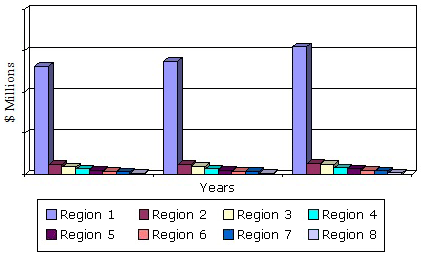
Wellesley, Mass., April 29, 2015 –BCC Research (www.bccresearch.com) reveals in its new report on Autism Spectrum Disorder (ASD), in 2013 the global markets were valued at approximately $346.2 million. The global therapeutics market for ASD accrued $305 million in 2013, while the global diagnostics market accrued $41.2 million. In 2014, the global ASD markets were recognized to have grown by 4.2% on a yearly basis, increasing to approximately $361 million.
ASD is a complex neurodevelopmental disorder that is characterized by deficits in social and communication skills, and by abnormal coherence to repetitive behaviors. ASD is claimed to be the fastest growing childhood disorder (13% to 15% annually), which manifests itself before the age of three. It is thought that there are more than 7.6 million people living with ASD-related disabilities, and since there is no cure or effective treatment, this population represents a vastly underserved global market.
While the underlying reasons for ASD are not well understood, the regulatory organizations are more concerned with the effectiveness and safety of the interventions than their mechanism. Due to this, drug developers rigorously investigate exhaustive molecular targets and mechanisms to discover a drug candidate without getting into complicated and mundane proof-of-mechanism studies.
“Considering that there are no other available tools to make a completely accurate diagnosis on the disorder, cytogenetic tests have become invaluable,” says BCC Research analyst Ufuk Ezer. “The current technologies can enable the detection of hundreds of genetic markers for ASD in short amounts of time. This is why technologies such as chromosome microarrays (CMAs) are considered as the first-tier tools for early diagnosis of ASD and other childhood developmental disorders by authorities such as the American Academy of Pediatrics, the American College of Medical Genetics and the International Standard Cytogenomic Array Consortium.” The setback for these diagnostic technologies, however, is the financial factor; microarrays and other genetic tests are very costly techniques.
Diagnostics and Therapeutics for Autism Spectrum Disorders: Global Markets elaborates on the definition, historical background, etiology and epidemiology of ASD by providing information on prevalence rates, disorder patterns, regional diagnostic criteria and underlying biological and environmental causes.

Editors and reporters who wish to speak with the analyst should contact Steven Cumming at steven.cumming@bccresearch.com.
Diagnostics and Therapeutics for Autism Spectrum Disorders: Global Markets( HLC181A )
Publish Date: Mar 2015
Data and analysis extracted from this press release must be accompanied by a statement identifying BCC Research LLC as the source and publisher. For media inquiries, email press@bccresearch.com or visit www.bccresearch.com/media to request access to our library of market research.
BCC Library Membership Benefits
Unlimited Access to Market Research Reports for Academic Institutions and Corporations.
Custom Research
Tailored solutions across industries for your unique business needs.
More in Health Maintenance
- Global Noninvasive Cancer Diagnostics Market to Reach $165.2 Billion by 2030 as Liquid Biopsy, AI-Enabled Screening and Multi-Cancer Detection Tests Transform Oncology
- Long-Term Care and Home Healthcare Technology Market to Reach $64.8 Billion by 2030 as Aging Demographics and Remote Monitoring Reshape Care Delivery
- Thermo Fisher Scientific Inc.: BCC Research Releases Comprehensive 360° Company Analysis
- Healthcare Predictive Analytics Market to Grow at 24.7% CAGR Through 2030
- mHealth Technologies Market Poised for 17.1% CAGR Growth Through 2030
Reports from Health Maintenance
Recent News
- Biometrics as a Service in Medical Devices to Reach $2.7 Billion by 2030, Driven by Remote Patient Monitoring Demand
- Protein Synthesis Research Market to Reach $42.8 Billion by 2031, Driven by Surging CGT Investment
- AI and Advanced Diagnostics Transform Cancer Detection Market Amid Rising Healthcare Investment
- Global Bispecific Antibodies Market to Reach $22.3 Billion by 2030 as Immuno-Oncology Innovation and R&D Investment Accelerate
- Cloud Computing in Cell Biology, Genomics and Drug Development to Reach $15.6 Billion by 2030 as Biological Data Explosion Drives Demand